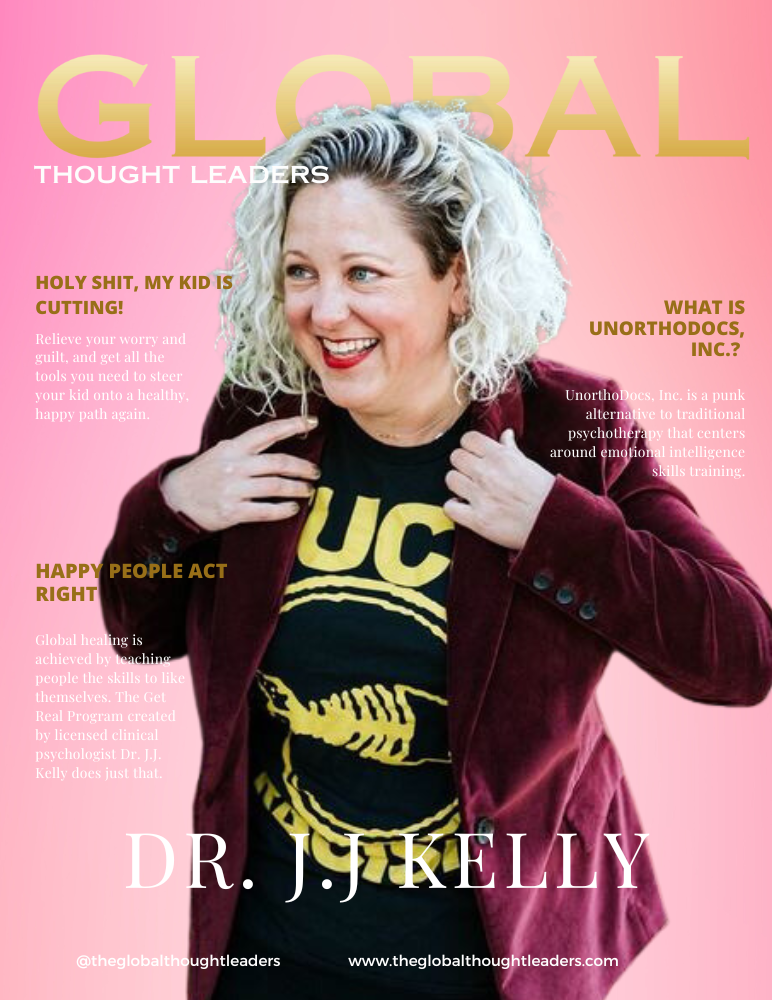

Exclusive Interview : Dr. J.J. Kelly Shares How to Build Awareness of Your Emotional Experiences
Dr. J.J. Kelly, The Punk Rock Doc, is a licensed clinical psychologist, emotional intelligence skills training expert, and bestselling author of The Holy Shit Series. J.J. is also the CEO & Founder of UnorthoDocs, Inc., a punk alternative to traditional psychotherapy. Dr. Kelly and the unortho “docs” live their lives with the belief that global healing is achieved by teaching people the skills to like themselves
After 16 years of passionately working in the current system of the mental health profession and seeing the systemic sexism, racism, homophobia, ableism, narcissism and elitism…Dr. J. J. wanted nothing more than to burn it all down.
Then she decided to redirect her outrage into building something new based on love, laughter, and teaching emotional intelligence – because she believe that global healing is achieved by teaching people the skills to like themselves, or as she always say….Happy People Act Right.
A huge thank you to BIPOC leaders that have paved the way by creating movements based on JOY AS RESISTANCE. Dr. J. J. hope she can contribute, use her white privilege productively and inclusively, and make you proud. “No one is free until we are all free.” – Martin Luther King, Jr.
I’m fascinated and I want to know more about the “Get Real” program. What is it?
It evolved from dialectical behavior therapy, which I’ve been teaching in different forms since 2004, and I did therapy, psychotherapy, psychoeducation for 20 years. But now the “Get Real” program is an eight-week program that distills the DBT modules, mindfulness skills, distress tolerance skills, emotion regulation skills, and interpersonal effectiveness skills.
You learn all kinds of tools and skills for when you get emotionally activated so you can continue to behave according to your values.
Wait a minute, though. We all have a problem; we all have trauma, so where do we start to get to work with you? A lot of people are stuck with themselves and they’re not reaching out. How can we get out of our own way and seek help?
The psych stuff is less stigmatized now post-pandemic; that’s maybe the one benefit of a very terrible situation. It really illuminated the fact that nobody has any emotional intelligence skills, and we better get some because if it ever happens again, we’re going to kill our family.
And it’s already happened a lot.
Yeah, and a lot of self-medicating behaviors, day drinking, overworking, and Netflix binging. All these things went way up during the pandemic because people didn’t know how to cope, and it’s understandable. Where do we learn the skills? Nobody teaches us. That’s my whole thing. Why isn’t it taught in schools?
I’m from Thailand, and growing up, I was just trying to figure out how to find food and not even thinking about that.
But a lot of kids here, their life is so convenient, that’s what I see. But we have bigger problems than the kids in third-world countries, mentally and emotionally speaking.
I don’t know if it’s bigger. It’s different, and teen suicide is through the roof. So that needs to be addressed.
But my whole thing, too, is it’s not just about keeping the kid or keeping the client alive. Dr. Marshall Anahan says, “Build a life worth living.” That’s kind of at the core of DBT. And increasing one’s capacity to experience joy. That’s kind of what it’s all about.
Do you help younger teens and their families or adults as well?
Yeah, I get a lot of CEOs and executives. That seems to be getting more popular. Emotional intelligence, EQ, it’s got to be corporate made into something clever.
Especially Silicon Valley, which is near where I live, and it’s a lot of talk about EQ. More talk than actual practice, in my opinion. But there are companies around the States and around the world that are genuinely interested in a work-life balance and not just saying that, but the practical steps to make that happen.
Do you believe in work-life balance?
Of course.
What does it look like for you?
I think it’s a lot of laughing in your daily life.
I need to improve more on that.
Yeah, you work very hard, and I come from that too. It was a real struggle to embrace concepts like surrender. I’m just used to fighting my way through things in my lifespan. And so, to actually embrace this idea of trusting and surrender, that has been work.
But anything new is scary, and we can do anything that we want. And I have a lot more of just doing nothing, and that recharges me on a level that’s hard to quantify. I can just see it play out in my life.
When people hear the word surrender, sometimes I think they think that it’s difficult to do or it’s related to yoga. You have to surrender during the yoga practice.
Right, or they put it with laziness, which of course, it’s not.
Or they procrastinate; they say okay, I’ll surrender later.
Yeah, that’s kind of a perversion of it. But the idea that life is sweeter and creativity comes from a relaxed place and surrendering control, or the concept, the figment of our imagination of control, I do think that allows for a more relaxed daily life that then allows for those creative ideas to come in.
I love that.
I don’t know if I’m right, but that’s what I think.
It sounds right to me because I’m already surrendering and relaxing listening to you right now.
But if I sit like this, that kind of thing too. What is the energy between us as we’re talking? And what is the eye contact? And we can feel the connection between us. We can feel some form of love between us. And I think that comes from just being ourselves.
For real being ourselves. Not performing relaxed and not performing being a good person, because I’m afraid people are going to judge me. That’s not what I’m talking about; that’s not real.
I think nowadays, though, people start to get comfortable, to be themselves more. I see it on social media. I don’t know if they say they are.
I don’t trust social media to give an authentic snapshot of who people are at all.
I don’t know, it’s easy for me to believe people.
That is great. I’d love to be wrong about that.
I see it play out with clients comparing themselves to what they see – young people and young adults. People are putting their star reel out there, and it’s not showing how they’re self-harming or they’re self-medicating at home or they’re just crying all the time.
So for your work, you’re also helping people to not depend on doctors and therapists and medicine. I am fascinated with that because it seems like we don’t have tools or we don’t know the tools to solve our fight. And our audience here, they are entrepreneurs too.
So can you give us some advice? I don’t want to say what are the three things, but some advice for entrepreneurs out there to really tune into themselves and not just rely on caffeine every day or whatever it is.
Yeah, I like working with entrepreneurs because there’s such a go-getter thing going on, doers getting shit done.
And that, when applied to the skills that I teach, makes them starve. The downside, however, for anybody, is buy-in.
It can’t be performed. I mean, it can to some extent. You could start new habits by just performing them when you’re not fully in and buying it yet. That can work for a little while. However, some of the skills – the mindfulness skills, the distress tolerance skills – are more amorphous and unknown, and you have to check in with who you are in order to figure those out.
And that requires a little bit of a slowdown, and that is tough with entrepreneurs to get them to chill out.
And we do a couple of minutes of a mindfulness exercise just to get them out of their head and into their body so that it’s not some sort of academic process that’s intellectualized. It needs to be practiced, and it needs to be integrated and digested.
It’s not just doing that’s going to get you to achieve your goal because it’s going to kill you too fast, too soon.
And I think the speed serves the purpose, let’s say, in America, to avoid being alone with ourselves in the quiet. I think that skyrockets most people’s fear and anxiety, and so they stay on that treadmill to nowhere, as I call it.
Survival mode.
Yeah and workaholism is self-medication too, but it’s so revered in our country, it’s not seen as something that might be negative. Now people are talking about burnout and impostor syndrome and things like that, and that’s a productive conversation.
At the core of it, though, is a lack of connection with self, in my opinion.
At the end of the day, you’ve got to come back.
And you’ve got to like yourself to be able to hang out with yourself. And that’s the whole thing, liking yourself. But these are very practical ways to get to that, because you’re going to like yourself if you behave according to your values in a consistent way. Regardless of whatever environment you’re in, you behave according to your values.
Whatever difficult person you’re in front of, you behave according to your values. You have the ability – you have the tools to manage the fear of being judged, the fear of being criticized openly. We call that water off a duck’s ass, other people’s stuff just sliding right off of you. And you get to be who you are in your values, in your integrity. That is a kind of freedom that I don’t think most people enjoy, unfortunately.
Well, again, we haven’t been trained or grown up that way. Our previous generation, our parents, they’re not that healthy either. And I have to forgive them because they didn’t know, they didn’t have the therapist that I have, they didn’t read the books that I read.
And there’s more information out there than there’s ever been about emotional intelligence.
People flooded the mental health system post-pandemic because they were like, whoa, I gotta learn emotional intelligence skills. I think the mental health system is pretty flawed and full of isms; that’s my take on that. However, people are asking for help now in a new way, so I teach them how to fish.
Do you think that a lot of younger people, because of technology and everything, are more stressed than the generation before?
I do think that they have stressors that we probably never thought of much.
My little ones are nine and thirteen years old, and they talk about stress, and that’s a lot. You’re only nine and you talk about stress.
Right, so what we do is break it down – what does stress mean? Does that mean something in the fear camp? Is that something in the shame camp? Shame is overlooked a whole lot. When you don’t behave according to your values, it creates shame.
But then what do we do? We put that away. I don’t want to look at that because it’s so uncomfortable. It causes so much stress to look at it, so I bury it away. And what does that do? It spikes anxiety, which increases the chances of behaving off your values again, creating more shame spikes and anxiety because you’re hiding the shame.
So as a parent or the adult in the family, how can we help our younger people to be less stressed, for example?
I think it all starts with printing out the emotions list, putting it on the fridge, and normalizing within the family naming emotions. So when a kid comes up and they’re obviously stressed, you say, “How are you feeling right now?” “Well, I feel like it’s not fair.” Okay, that’s not a feeling; that’s a thought. How do you feel? Go to the list. Mom, I don’t want to go to the list. Go to the list.
And then discipline within the family starts about naming one’s emotions instead of just projecting that emotion out onto someone else in the form of blame and criticism. That’s what we do. We just project out all of our negative emotional experiences instead of walking it back and asking ourselves, what do I feel right now?
We go, oh, you triggered me. Blame, blame, blame. As if triggers aren’t our responsibility to manage. We actually tell ourselves that if that thing out there changed, we would feel happy. It’s ultimate bullshit.
Right? It’s not true.
Not at all. Freedom comes from whatever stimuli is out there. I behave according to my own values, therefore I live in my own self-esteem, my own self-confidence. And, of course, I’m going to get thrown off by different things at different times. But the practice is behaving according to my values, regardless of emotional activation, regardless of the environment that I’m in.
That is freedom all the time.
I can see the future is coming, global healing. Talk a little bit more about that and share with us.
Well, that’s the line. Global healing comes from teaching people the skills to like themselves. I absolutely believe it can be achieved by teaching people the skills to like themselves, because what I see over and over is when people get whole.
They’ve built their self-esteem and they’ve built their self-confidence by using the tools to continue to behave according to their values. Now they’re just getting stronger, they’re getting more sparkly, they’re getting more lively. Then what is the natural byproduct of that? It’s an overflow in the form of generosity, in the form of giving, in the form of kindness.
The docs, the advanced students, they want to mentor the youngins. The baby docs, as we call them, the CEOs want their team to be happy and to have a better way of resolving conflict at work.
There is a natural desire to spread joy and love once you are regularly experiencing it, and that’s what I’m after.
But you can’t do this alone.
I know, I’ve been lone wolfing it for so long. That’s why we met, I’m so lucky.
We’re talking about global healing. Please, Dr. J.J. cannot do this alone. She cannot heal the whole world by herself.
I do try.
We need each other.
Yeah, we do.
With my work, I want to create an impact, but I can’t create that impact alone. And I’m so thankful that we met.
I am too, because I need that reminder because of the habit of lone wolfing it.
And community is really important – it has taken me a while to figure that part out.
And the family institution, parents, you need to like yourself first before you teach the kids to like themselves. It’s important.
Modeling is such a great way to teach because you don’t even have to have a conversation. You’re just doing the thing. I let myself be weird.
No, you are being you. Other people might think that it’s weird, but that’s okay.
I don’t think of it as a negative word, but yes, we all have unique things about us, and because of fear of judgment, we don’t show everybody everything.
And I wouldn’t say I show everybody everything, but I’m pretty out there with who I am. And I think that’s modeling. Being self-confident and liking yourself, that is an invitation for others to do the same. I don’t have to say, “Hey, I invite you to be yourself.” I’m just doing it.
Then they’re comfortable enough to be themselves around you because you’re comfortable, right?
Yeah, and that validation just from one person can be a vehicle for healing a lot of deep wounds, and that’s a beautiful thing.
So here’s a funny question. You’re wearing pink glasses. Is it because you want to see the world pink?
I get hassled a lot about that, especially from the teens, in a light-hearted way.
I started doing that like 20 years ago, and then the eye doctor said that’s actually the color that’s best for filtering out UVs from the computer. So, bonus on that.
Really? Well, you might see someone wearing pink glasses like you from now on.
Whatever blows your hair back, whatever makes you happy, do that.
So, if someone’s really in a dark place and they don’t like themselves anymore and they are done with themselves, what is one thing that you want to share with them?
This too shall pass. That’s real. You have to ask for help; though it doesn’t get better automatically, sometimes it does, and sometimes it just passes on its own. It usually will circle back around if in that time you don’t ask someone for help. Ask a friend, ask a professional, ask wherever you get some validation.
But you have to ask for help and tell the truth. If you filter it out and you try to make it seem like it’s not as bad as it actually is, then you’re kind of betraying yourself even in asking for help.
But I get why people do that because a lot of times you show vulnerability to somebody with no emotional intelligence skills, and then they anxiously try to make you lock it up because they’re anxious about your discomfort.
That is such a tragic miss that happens all the time. Do not try to solve other people’s problems. Just listen. Active listening is an act of love. It’s so rare to just zip it and listen, and it is so calming for people. I watch people’s shoulders drop as I just listen and nod and look into their eyes.
They know I have problem-solving skills too, but I wait. I let them have the space to tell me what they think they can’t tell people, and I’ll just sit with them in that and hold them in that. We got plenty of time to talk about problem-solving.
When someone comes to you and they’re distressed, just breathe and listen and ask them, “Is this one of those things where you want to vent, or are we problem-solving?” And if they say vent, zip it. Do not say there’s a compulsion to problem-solve.
There we go. That’s a skill.
Yes. Be quiet, be with somebody. Actively listen to show them love. I stop them when they start to repeat themselves. If they start to get compulsive with bitching about something, then I’ll get in there, and I’ll disrupt that. But I’ve been doing this a long time.
Exactly, but normal people haven’t been trained in that skill.
Then ask them, is this a vent or is this problem-solving? That alone would change the world. The naming of emotions, keeping them separate – feelings vs. thoughts – and is this a vent or a problem to solve?
Those three things, if everybody did that, the world would be a better place.
Now I’m fascinated with your book as well, the Holy Sh*t series, and you have two new books coming up. Tell us a little bit about the Holy Sh*t series and then the two new books that you have.
Well, the first book, Holy Sh*t, My Kid is Cutting is a parenting manual. Whether your kid is self-harming or not, specifically, chapter ten is doing family contracts, which also goes on the fridge with the emotions list.
And you have an audiobook, too, correct?
Yes. I think that’s got to be more fun because I’m reading it, and I told my producer to leave in the parts where I’m laughing or mistakes are made because it’s more important to demonstrate that imperfect is okay.
Yeah, exactly. So that’s the first one, and then what’s the second one?
The second one is the one everybody needs. Holy Sh*t, I’m a Gifted Misfit, that is the eight-week course in a very thin book. Everything you need to know is in that gifted misfits book.
Don’t miss it, and then the third book?
The third book is Holy Sh*t I’m Dealing With a Narcissist. That’s the one that everybody loves. But the gifted misfit is the one that they need.
The third one is for both men and women, right?
They’re all for everybody of any gender or no gender.
What about the fourth one?
The fourth one is the prevention and treatment of Incels. Although I can’t market it that way because that’s already insulting. But it’s Holy Sh*t, What Do Women Want? The Young Gentleman’s Guide to Creating Love and Partnership. I have had a lot of young and not-so-young men come in and want a relationship.
So that’s me doing my part for the straight white men of the world and trying to get them acting right.
We’re talking about global healing people, right?
Exactly, we have to address the isms, but not cram them down people’s throats. The gifted misfits book is completely in they/them pronouns and nobody’s ever even noticed.
What about the last one?
The last one is about anger, and I don’t totally know the title of that, but it addresses explosive and implosive anger.
This toxic positivity thing is not the answer to the anger in our country and in the world. We have to really get some education around healthy expressions of anger.
I love that. Everyone go check out Dr. J.J. Kelly’s website and Amazon. And I know you have camps coming up and your “Get Real” program. How can they reach out to you?
I think the easiest way is my website, http://www.drjjkelly.com. I have tons of free content on Insta and TikTok because of the younger folks that I work with. So Instagram and TikTok are also Dr. J.J. Kelly.
I always say just Google me. Google Dr. J.J. Kelly and you will find her and follow her and learn from her because we need each other.
Heal yourself. Heal your family. Heal each other. Thank you so much, Dr. Thank you. Thanks a lot. Thanks.
Contact Dr. J.J Kelly :
http://www.drjjkelly.com
IG : drjjkelly
FB : Dr. J.J Kelly